Shopping Cart
Your cart is empty
Total: EGP 0


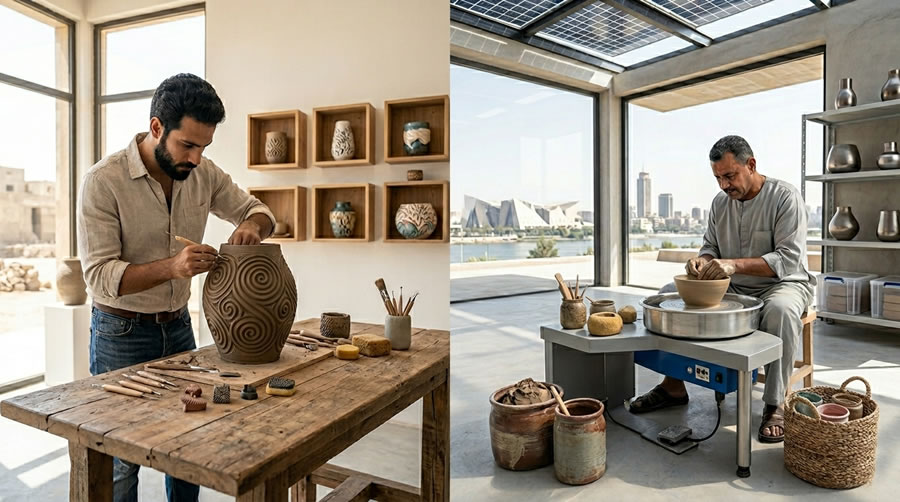
Walk into any pottery supply shop in Cairo and you'll face the same question: natural clay or processed clay? It's not a simple choice. Both have passionate advocates. Both produce beautiful work in the right hands. But for Egyptian potters working in our specific climate and market conditions, one might serve you better than the other. Let me help you figure out which.
Natural clay comes straight from the earth with minimal processing. In Egypt, we're blessed with rich clay deposits along the Nile. Some potters still dig their own clay, processing it by hand using traditional methods passed down through generations. There's something romantic about that connection to ancient Egyptian pottery traditions.
But romance doesn't always pay the bills. Natural clay varies dramatically from batch to batch. The clay you dig in summer might behave completely differently from winter clay. Iron content fluctuates. Soluble salts vary. Organic material changes with the seasons. For potters producing consistent work for sale, that unpredictability can be a nightmare.
That said, natural clay has advantages. It's cheaper—sometimes dramatically so. It connects you to thousands of years of Egyptian pottery tradition. And many potters genuinely prefer the character and feel of natural clay bodies. The subtle variations that drive production potters crazy can create beautiful, unique effects that processed clay can't replicate.
Processed clay like Middle White Clay and High White Clay starts with natural clay that's been refined, blended, and tested for consistency. Every bag performs the same way. Same plasticity. Same drying shrinkage. Same fired color. Same thermal expansion. That consistency is gold for production potters.
I watched a potter in Alexandria process fifty pounds of Middle White Clay last month. Every piece threw the same way. Every piece dried without cracking in Alexandria's humid air. Every piece fired to the same warm white. He told me he couldn't remember the last time he had that kind of reliable result with natural clay.
The downside? Processed clay costs more. You're paying for that consistency. But for many Egyptian potters, the predictable results easily justify the higher price. Less waste. Fewer failed pieces. More consistent production. Over time, the math often works out in favor of processed clay.
Let's stop talking about theory and talk about what actually happens in Egyptian pottery studios. Here's what matters:
Here's my honest advice after talking to dozens of Egyptian potters: start with processed clay. Learn what consistent, reliable clay feels like. Build your skills on a foundation that doesn't fight you. Once you've mastered your techniques and understand exactly what you need from your clay, then experiment with natural clay if you're curious.
Most Egyptian potters I know end up using processed clay for their production work and natural clay for special projects or experimental pieces. That balance gives you the best of both worlds: reliability where you need it and character where you want it.
Ready to try processed clay like Middle White Clay or High White Clay in your studio? Your consistent results are waiting.