Shopping Cart
Your cart is empty
Total: EGP 0


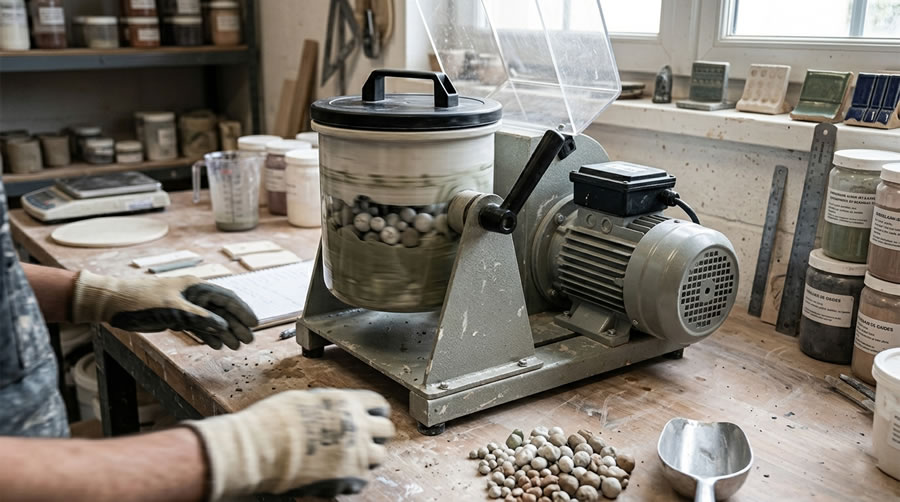
If you've never milled your own glazes, you might not understand why anyone would bother. Pre-mixed glazes are convenient. Open the bottle, apply, fire, done. But convenience comes with limitations. You're limited to whatever colors someone else decided to make. You can't adjust the formulation. You're paying for water weight in shipping. And you're completely dependent on your supplier's inventory and delivery schedule.
Formulating your own glazes changes everything. You control the ingredients. You control the colors. You control the cost. And the tool that makes it all possible is a ball mill. More Egyptian glaze formulators are choosing the Single Ball Mill 20L. Here's why.
Let me answer the question you might be asking: why bother? Here's what milling your own glazes gives you:
Complete formulation control. Want to adjust a glaze recipe? You can. Want to create a custom color that no supplier offers? Go ahead. Want to eliminate an expensive ingredient or substitute something more available locally? That's your choice. You're not limited to someone else's formula.
Significant cost savings. Pre-mixed glazes are mostly water. You're paying to ship water across borders. Buy dry materials, mill them yourself, and you're only paying for what matters. The savings add up quickly, especially for production potters going through gallons of glaze every week.
Consistent results. Commercial glazes change between batches. Raw material variations, manufacturer substitutions, storage conditions—all affect the final result. When you mill your own, you control everything. The glaze you fire next month will match the glaze you fired today.
A glaze formulator in Cairo who supplies several pottery studios told me: "I was buying commercial glazes and reselling them. The margins were terrible, and I had no control over quality. Now I mill my own using the 20L ball mill. My costs dropped by 60%. My customers get consistent results. I'm actually making money instead of just moving boxes."
Small ball mills (5L, 10L) work fine for testing and small studios. But if you're serious about glaze formulation—if you're supplying multiple studios or running significant production—you need larger capacity. The Single Ball Mill 20L hits the sweet spot: enough capacity for real production without being so large that it's impractical for studio use.
What can you do with 20 liters?
A production potter in Alexandria who fires three kilns weekly told me: "I was using a 5L mill and running it constantly. Mill a batch, unload, mill another batch, unload, all day long. The 20L mill lets me mill my weekly glaze requirement in two or three batches instead of fifteen. That's hours of time saved every week."
For production work, time saved is money earned.
Different materials require different milling approaches. Hard materials like quartz and feldspar need aggressive milling. Soft materials like pigments need gentler treatment to avoid over-grinding. The Single Ball Mill 20L features adjustable speed control that lets you optimize the process for whatever you're milling.
Run it faster for coarse materials that need reduction. Slow it down for pigments that only need to be deagglomerated. Find the exact speed that gives you optimal results for your specific materials. That flexibility is essential for serious glaze formulators who work with a variety of raw materials.
"I mill everything from hard feldspar to soft stains," a Cairo glaze formulator told me. "The speed adjustment on this mill is precise. I can dial in exactly what each material needs. My feldspar comes out consistently ground. My stains don't get over-milled. It's made a huge difference in my final glaze quality."
The 400W motor provides reliable power for extended milling sessions. Whether you're running a quick 30-minute batch or letting the mill run overnight for fine grinding, the motor handles it without overheating or losing performance.
Ball mills take abuse. You're grinding hard materials, running the machine for hours, dealing with dust and vibration. Cheap mills fail quickly under these conditions. The Single Ball Mill 20L is built for real-world use.
The robust construction handles continuous operation. The drum seals keep material contained. The bearings are designed for the loads and speeds of ceramic grinding. And the 220V motor is compatible with Egyptian electrical standards.
A studio owner in Maadi who processes all his own glazes and clay bodies said: "I run my 20L mill almost every day. Sometimes for 12 hours straight. It hasn't missed a beat in two years. I've had to replace a belt and lubricate the bearings, that's it. This thing is a workhorse."
This mill is for anyone serious about glaze formulation or material processing:
The bottom line? If you're ready to take control of your glaze formulation, the Single Ball Mill 20L gives you the capacity, control, and durability you need. Egyptian glaze formulators are choosing it for good reason.
Ready to start milling your own glazes? Consistent results are waiting.