Shopping Cart
Your cart is empty
Total: EGP 0


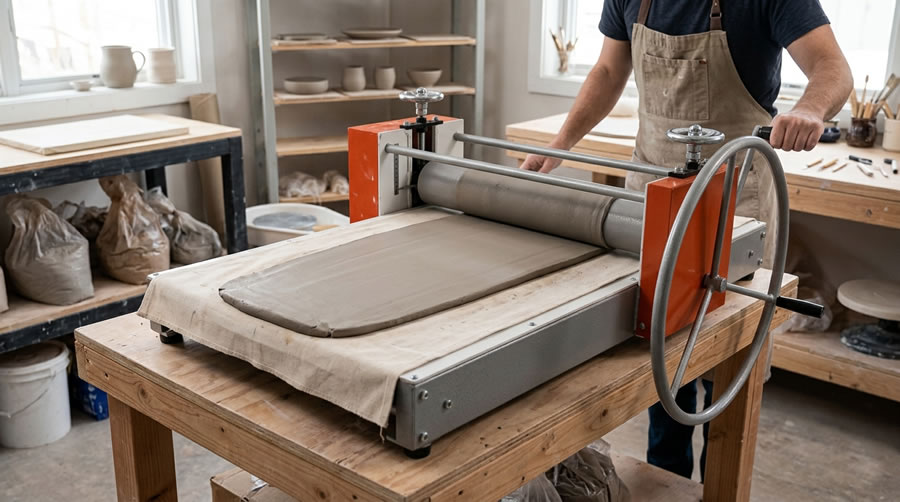
Hand-building is having a moment in Egypt. More potters are discovering that you don't need a wheel to make beautiful ceramics. Slab building, coil construction, and sculptural forming offer creative possibilities that throwing simply can't match. But great hand-building starts with one thing: perfect clay slabs. Uneven thickness leads to warping. Inconsistent density causes cracking. And hand-rolling with a pin? It's slow, exhausting, and rarely produces truly uniform results. That's why serious hand-builders use a slab roller. And more Egyptian potters are choosing the Slab Roller Dual Axis every year.
Most slab rollers work on one axis. You feed clay through, it comes out the other side, done. That works fine for many applications. But single-axis rollers have a limitation: they compress clay primarily in one direction. That can create internal stresses that lead to warping during drying and firing.
The Slab Roller Dual Axis solves this problem by rolling clay in both directions. Feed the slab through once. Rotate it 90 degrees. Feed it through again. The dual-axis compression eliminates directional stresses, resulting in slabs that stay flat through drying, bisque, and glaze firing. No warping. No curling at the edges. Just perfectly flat, stable slabs every time.
A hand-builder in Alexandria explained it this way: "I used a single-axis roller for years. My slabs were fine. But I always had some warping, especially with larger pieces. I thought that was just normal. Then I tried a dual-axis roller. The difference was immediate. My slabs stayed completely flat. No warping at all. I couldn't believe I'd been accepting mediocre results for so long."
That's the dual-axis difference. Not incremental improvement. Genuinely better results.
Slab rollers take abuse. You're applying significant pressure, rolling clay back and forth, using the machine constantly if you're serious about hand-building. Cheap rollers flex under pressure, producing slabs that are thicker in the middle than at the edges. The Slab Roller Dual Axis is built differently.
The durable metal frame provides rigid support across the entire rolling surface. No flex. No give. Just even pressure from edge to edge. The PE (polyethylene) rolling surface is smooth and non-stick, releasing clay easily while providing excellent compression. The crisp white finish isn't just for looks—it's durable and easy to clean.
A studio owner in Maadi who teaches hand-building classes told me: "My students are not gentle with equipment. They leave clay to dry on the roller. They forget to clean it properly. They roll slabs that are way too thick. This dual-axis roller has survived two years of student abuse without any problems. The frame hasn't warped. The rolling surface still looks almost new. It's the most durable piece of equipment in my studio."
When you're investing in equipment that needs to last, durability matters.
Small slab rollers limit what you can make. You're constantly piecing together multiple slabs for larger projects, which means visible seams and structural weaknesses. The Slab Roller Dual Axis gives you 106 x 55 x 108 cm of working space. That's enough for:
A production hand-builder in Cairo who makes hundreds of slab-built pieces each year told me: "I upgraded from a small roller to this dual-axis model. The size difference alone was worth it. I can roll slabs for four platters at once now. That's cut my prep time in half. Plus the dual-axis compression means I don't have to worry about warping anymore. My reject rate has dropped dramatically."
For production work, efficiency gains like that directly impact your bottom line.
This roller is for anyone serious about hand-building. That includes:
A ceramic tile manufacturer in Alexandria switched to this roller for production. "We were cutting tiles by hand. Inconsistent thickness meant inconsistent firing. Too many rejects. This dual-axis roller gives us perfectly uniform slabs every time. Our reject rate went from 15% to under 3%. That's real money."
If you're serious about hand-building, you need a serious slab roller. The Slab Roller Dual Axis delivers dual-direction compression for truly flat slabs, generous working dimensions for large-scale work, and durable construction that survives daily use. Egyptian hand-builders are trusting it for good reason.
Ready to take your hand-building to the next level? Perfect slabs are waiting.