Shopping Cart
Your cart is empty
Total: EGP 0
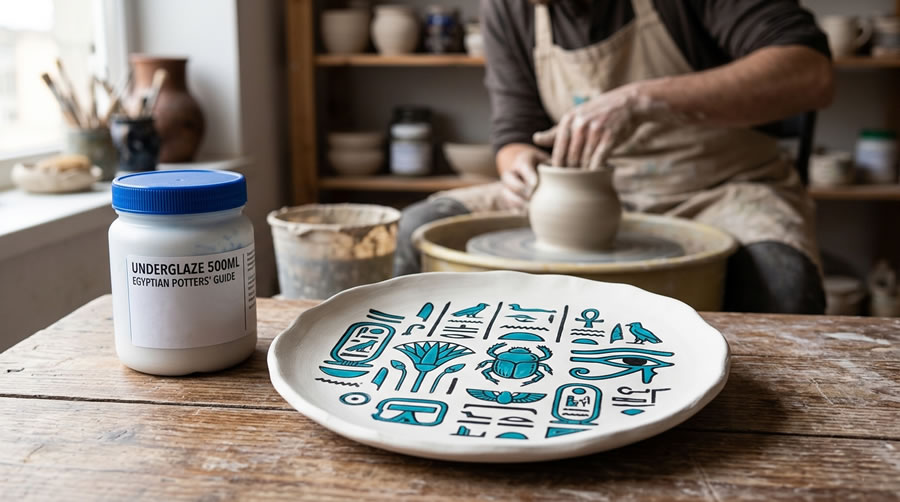
There's a reason underglazes have become essential in Egyptian pottery studios. They give you something that traditional glazes don't: control. With underglazes, you can paint detailed illustrations, layer colors for depth, carve through to reveal contrasts, and create surface decoration that looks exactly how you intended—before and after firing. Underglaze 500ml brings all that possibility to your workspace in generous, studio-friendly bottles.
Traditional glazes are beautiful, but they're also unpredictable. They move in the kiln. They blend in unexpected ways. Sometimes those surprises are wonderful. Sometimes they ruin hours of careful work. Underglazes are different. They stay exactly where you put them. No bleeding. No running. No unwanted surprises.
A potter in Heliopolis discovered this when she started making illustrated plates. "I was trying to paint detailed scenes with regular glazes," she told me. "But the colors would bleed during firing. Fine lines became blobs. Details disappeared. I was so frustrated. Then someone showed me underglazes. Suddenly my lines stayed crisp. My details remained visible. I could actually paint what I wanted to paint."
That precision is what makes underglazes so valuable. They're essentially ceramic paints that behave predictably, firing to vibrant, durable colors that don't fade over time.
Small underglaze bottles look cute on shop shelves. But if you're actually making pottery—not just occasionally, but regularly—you know how fast they disappear. A few test tiles here, a couple of plates there, and suddenly that tiny bottle is empty.
Underglaze 500ml bottles solve that problem. They're sized for real studio use. Enough volume to decorate dozens of pieces. Enough to experiment without worrying about running out. Enough to develop a consistent body of work without constant reordering.
A production potter in Alexandria told me: "I was buying those little bottles and running out constantly. Every week, another order. More shipping costs. More waiting. Since I switched to the 500ml size, I order less often and save money. Plus I'm not constantly rationing my underglaze, worried I'll run out mid-project."
For Egyptian potters watching costs and managing supply chains, that matters.
Let me walk you through what's possible with these underglazes. Not theory. Actual techniques Egyptian potters are using right now:
Hand-painting. The most direct application. Brush underglaze onto greenware or bisque like paint on canvas. Create illustrations, patterns, abstract designs, anything you can imagine. The smooth formula applies evenly without streaking or skipping.
Layering. Apply one color, let it dry, apply another on top. Fire. The layers remain distinct, creating depth and complexity you can't get from a single glaze application. Some Egyptian potters are layering five or six colors to create rich, painterly surfaces.
Sgraffito. Apply a layer of underglaze to leather-hard clay. Let it dry to the right consistency. Then carve through it with a needle tool or carving knife, revealing the clay body underneath. The contrast between colored underglaze and natural clay creates stunning graphic effects.
Mishima (inlay). Carve lines into leather-hard clay. Fill the lines with underglaze. Wipe away the excess. Fire. The underglaze remains only in the carved lines, creating precise, clean line work that looks almost printed.
Watercolor effects. Dilute underglaze with water and apply like watercolor paint. The more water you add, the more transparent the effect. Build up layers gradually to create subtle shading and depth.
A potter in Maadi combines several of these techniques. "I'll paint a base layer of color, let it dry, add a second layer in a different color, then carve through both to reveal the clay body underneath. Sometimes I'll add more colors on top after bisque. The results are incredibly rich. My customers always ask how I did it."
Like all quality ceramic materials, not all underglazes perform the same way. Some are formulated for low-fire only. Others change color dramatically at higher temperatures. Some bleed or blur when you apply clear glaze over them.
Underglaze 500ml is formulated for mid to high-temperature firing—the temperatures most Egyptian studios already use. The colors stay stable and vibrant from bisque through glaze firing. No unwanted color shifts. No bleeding under clear glaze. Just reliable, predictable performance batch after batch.
"I tested five different underglaze brands before settling on this one," a Cairo ceramic artist told me. "Most of them changed color in my kiln. One turned from blue to green. Another from red to brown. This one stayed exactly the same color it said on the bottle. When I'm selling work, I need to know what I'm getting. This gives me that confidence."
Underglazes are for anyone who wants detailed control over surface decoration. That includes:
The bottom line? If you want to paint on clay the way you'd paint on canvas—with control, precision, and predictable results—Underglaze 500ml is your medium. Your best surface decoration is waiting to be painted.
Ready to take your surface decoration to the next level? Your most detailed work is waiting.